
When a bowl noodle line runs at full tilt, the packaging end is where things either hold together or fall apart. Cups tip. Trays shift. Film wrinkles. And every stopped minute costs more than the film itself. The RS-590 was designed around that reality—not around a spec sheet.
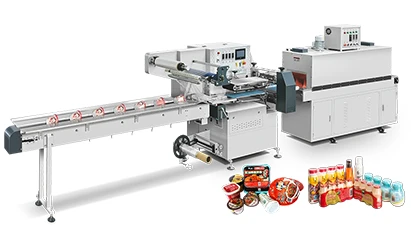
A Closer Look at the RS-590 Flow Type Shrink Packing Machine
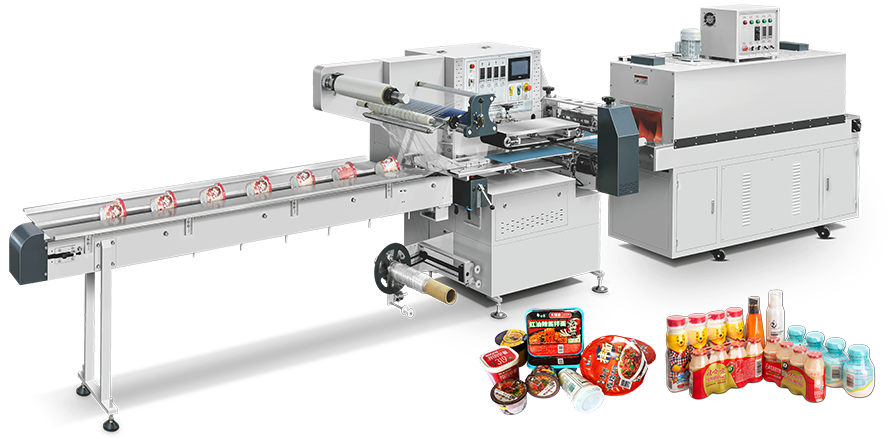
The RS-590 comes in two film-width configurations: the RS-590 with a 590mm film web, and the RS-720 with 720mm, both paired with the RT-3025S shrink tunnel. The wider version handles larger multi-packs and taller bowl formats, while the standard RS-590 covers most single-row cup and bowl applications. Both are inline flow-type machines—product enters on a conveyor, gets wrapped in a continuous film tube, sealed, cut, and shrunk in one pass. No manual loading, no batch handling.
Technical Specifications
| Specification | Details |
|---|---|
| Model | RS-590 + RT-3025S / RS-720 + RT-3025S |
| Packing Speed | Up to 120 packs/min |
| Sealing Precision | ±1 mm |
| Drive System | 3 independent servo motors (infeed conveyor / sealing cutter / film delivery) |
| Control | PLC color touch screen with recipe storage |
| Film Type | POF single-layer, 11–19 μm |
| Shrink Tunnel | RT-3025S, dual temperature zone, independent control |
| Film Waste Recovery | Wrap-around scrap recycling device |
| Power Supply | 220V 1-phase (sealer) / 380V 3-phase (tunnel), total 17.5 kW |
| Optional | Ink wheel coder, intelligent coder, spray coder |
What These Numbers Mean in Practice
The 120 packs/min figure is not a laboratory peak—it is the rated continuous output when film tension and sealing temperature are set correctly. The ±1mm tolerance is the number that matters after six months of production, not on day one. And the three-servo architecture is what keeps both numbers from drifting when you switch from a 75mm cup to a 120mm bowl.
Three Servo Motors and What They Change on the Floor
Plenty of machines claim servo drive. The RS-590 uses three independent servo axes: one for the infeed conveyor, one for the sealing cutter, and one for film delivery. Each adjusts through the PLC touch screen, which means changing product length does not require touching a mechanical eccentric device. There is no cam shaft to re-time. An operator can pull up a saved recipe, load the matching infeed fixture, and run.
Why ±1mm Precision Holds Up at 120 Packs per Minute
At high speed, the cutter and the film feed have to stay in sync within a very narrow window. If film delivery lags even slightly, the seal lands off-center. The servo closed-loop control on the RS-590 corrects that continuously, not just at startup. The practical result is fewer mis-sealed packs, less film pulled into the cutter, and a scrap rate that stays predictable across a full shift.
Details That Affect Daily Output
The difference between a good shift and a frustrating one usually comes down to small things. The RS-590 addresses several of them directly.
Waste Film Recovery That Actually Pays Back
The machine uses a wrap-around scrap recycling device rather than a traditional center-fold setup. In real production, that translates to roughly 20% less film consumed compared to a conventional center-fold shrink packing machine. Over a year of two-shift operation, that is not a minor saving. It also means less film wound onto the take-up reel, which reduces how often operators stop to change reels.
Dual-Zone Shrink Tunnel
The RT-3025S tunnel runs two independent temperature zones. The first handles the initial shrink; the second locks the wrap tight without over-heating the seal. Independent control lets you tune the profile for thin POF film on a lightweight cup without scorching the rim, or run heavier film on a multi-pack bowl without leaving slack. Hot air circulation keeps temperature even across the tunnel width, which matters most at the edges of the belt.
Positioning Stop Function
When the machine stops—end of shift, film roll change, or an upstream gap—the sealing cutter parks away from the film. This prevents the knife from sitting hot against the web and burning a hole or welding the film shut. It sounds minor until you have had to cut out a fused section at the start of a shift.
Optional Coding Integration
For brands that need date codes or batch numbers on-pack, the RS-590 accepts ink wheel, intelligent, or spray coders. The mounting point is built into the frame, so adding a coder later does not require re-engineering the film path.
After-Sales Support for the RS-590
A shrink packing machine is only as reliable as the support behind it. The RS-590 ships with a one-year whole-machine warranty, excluding consumables damaged by improper operation. Original spare parts are available at cost price year-round, with express dispatch for overseas buyers.
Installation and operator training are handled on-site by Ruiyuan technicians, typically over one to two working days. Remote diagnosis is available for troubleshooting before a service visit is scheduled. The machine also ships with a detailed manual covering installation, changeover, and common fault codes, so your maintenance team is not starting from zero.
Summary
The RS-590 is not the cheapest flow wrapper on the market, and it is not meant to be. It is built for producers who need bowl noodles, cups, boxed fast food, and similar products to run at 120 packs/min without trading away seal quality or spending half a shift on changeover.
-
Three independent servo axes—infeed, cutter, and film delivery—all adjustable from the PLC touch screen
-
120 packs/min with ±1mm sealing precision that holds across a production run, not just at demo speed
-
Wrap-around waste film recovery saves roughly 20% film compared to center-fold machines
-
Dual-zone shrink tunnel with independent temperature control for thin POF and heavier film alike
-
Positioning stop function protects both the sealing knife and the film during idle periods
-
One-year warranty, on-site training, and remote diagnosis support
Have a Specific Production Target in Mind?
If you are weighing the RS-590 against another automatic shrink packing machine for your bowl noodle, cup, or boxed fast food line, the fastest way to a clear answer is to send us your product dimensions and target output. We can run a sample test and tell you which film width and infeed configuration fits—without a sales pitch attached.